
Microsoft Foundry’s MAI‑Transcribe‑1: Cheaper Speech‑to‑Text Lands in Azure (and Why .NET Teams Should Care)
TL;DR
Microsoft quietly shipped MAI‑Transcribe‑1 into Azure AI Foundry public preview this week. It’s a first‑party speech‑to‑text model with ~50% lower GPU cost, solid multilingual coverage, and clean Foundry + .NET integration. If you run call centers, meeting transcription, or voice‑driven agents on Azure, this is worth a serious look.
The news, narrowly scoped
On April 8–9, 2026, Microsoft announced that MAI‑Transcribe‑1 is now available in Azure AI Foundry (Foundry Labs) as a public preview model (techcommunity.microsoft.com). This isn’t a research teaser or a “waitlist” drop—it’s usable today inside Foundry projects.
Key facts straight from Microsoft:
- First‑party Microsoft AI (MAI) speech recognition model
- Enterprise‑grade accuracy across 25 languages
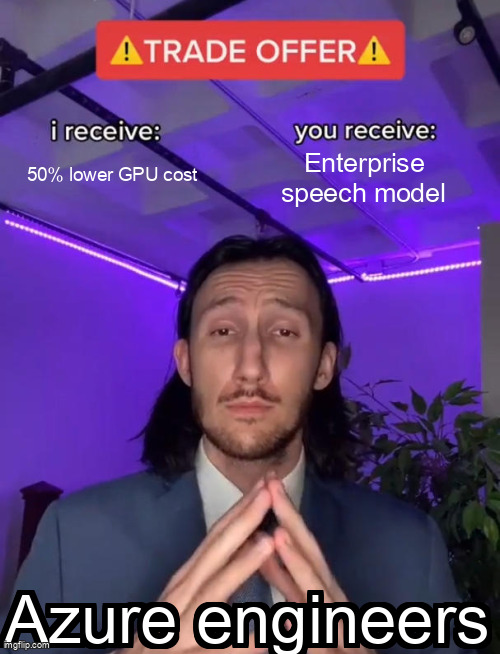
- ~50% lower GPU cost compared to leading alternatives
- Designed for production voice workloads, not demos (techcommunity.microsoft.com)
This is part of a broader push to make Foundry a complete AI stack—models, governance, evaluation, and deployment under one roof (techcommunity.microsoft.com).
Why this matters to .NET and Azure engineers
1. Cost pressure just eased (meaningfully)
Speech‑to‑text is deceptively expensive at scale. Call centers, compliance recording, and real‑time assistants burn GPU minutes fast.
A ~50% GPU cost reduction changes architecture conversations:
- Batch transcription becomes cheaper than “do we really need this?”
- Real‑time transcription is no longer reserved for premium SKUs
- You can justify always‑on transcription for agent assist scenarios
That’s not a rounding error—that’s budget‑line‑item impact.
2. First‑party model = fewer surprises in Azure
Unlike third‑party models:
- Identity, networking, and compliance align cleanly with Azure
- You get Foundry’s governance, safety, and evaluation tooling
- Enterprise customers avoid vendor sprawl and custom contracts
If you’ve ever had to explain why audio data briefly left Azure, you’ll appreciate this.
Using MAI‑Transcribe‑1 from .NET (conceptually)
MAI‑Transcribe‑1 is consumed through Azure AI Foundry, not as a standalone SDK. For .NET teams, the happy path looks like:
- Create or open a Foundry project in Azure
- Enable MAI‑Transcribe‑1 in Foundry Labs
- Call the transcription endpoint using standard Azure auth
- Stream or batch audio from your app
In modern .NET stacks, this pairs nicely with:
- ASP.NET Minimal APIs for ingestion
- Azure Event Grid / Service Bus for async pipelines
- Microsoft.Extensions.AI abstractions (where applicable)
Pseudocode sketch (simplified):
var client = new FoundrySpeechClient(
    endpoint: foundryEndpoint,
    credential: new DefaultAzureCredential());

var result = await client.TranscribeAsync(
    audioStream,
    language: "en-US");

Console.WriteLine(result.Text);
Exact APIs may evolve during preview, but the model fits cleanly into existing Azure patterns.
Latency and real‑time scenarios
Microsoft positions MAI‑Transcribe‑1 for:
- IVR systems
- Live agent assist
- Post‑call summarization
- Voice‑driven AI agents (techcommunity.microsoft.com)
In practice, this pairs well with MAI‑Voice‑1 for full duplex voice agents—listen, reason, respond—entirely inside the Microsoft stack.
Preview caveats (read this before shipping)
This is a public preview:
- SLAs may be limited
- APIs can change
- Regional availability may lag
For production workloads, the safe approach is:
- Start with shadow traffic
- Compare accuracy vs. your current STT provider
- Validate cost assumptions using real audio, not samples
When you should adopt it now
✅ You already use Azure AI Foundry
✅ Speech‑to‑text is a major cost center
✅ You want first‑party Azure governance and compliance
🚫 You need guaranteed GA SLAs today
🚫 You rely on niche languages beyond the supported set
🚫 You’re locked into a non‑Azure inference stack
Bottom line
MAI‑Transcribe‑1 isn’t flashy—but it’s practical. Lower cost, solid accuracy, and tight Azure integration make it one of the most relevant AI updates this week for engineers actually shipping software.
Sometimes the biggest AI wins aren’t new models—they’re cheaper ones that finally let you turn features on by default.
Further reading
- https://techcommunity.microsoft.com/blog/azure-ai-foundry-blog/whats-new-in-foundry-labs—april-2026/4509714
- https://techcommunity.microsoft.com/blog/azure-ai-foundry-blog/introducing-mai-transcribe-1-mai-voice-1-and-mai-image-2-in-microsoft-foundry/4507787