
The Azure AI Stack Gets Louder, Smarter, and More Agentic — Weekly Roundup (Apr 12, 2026)
TL;DR
This week’s Microsoft‑centric AI news is all about shipping: production‑ready agent frameworks, a newly GA‑adjacent Copilot SDK, and Azure AI Foundry doubling down on first‑party models and tooling. For .NET and Azure engineers, the story is less “wow, new model” and more cost curves, latency wins, and cleaner integration paths.
1) Azure AI Foundry Labs: faster iteration without breaking prod
Microsoft quietly made Foundry Labs the place where experimental AI features surface before they harden into GA services. The April 2026 update emphasizes rapid model iteration, evaluation tooling, and agent experimentation — without forcing teams to bet production reliability on previews (techcommunity.microsoft.com).
Why this matters
- You can test new modalities (voice, image, agent orchestration) alongside existing Azure AI workloads.
- Labs features are isolated, which helps with compliance reviews and internal platform approvals.
Practical takeaway If you run a platform team:
- Treat Foundry Labs like a canary environment.
- Gate promotion to standard Azure AI services via cost + latency benchmarks, not vibes.
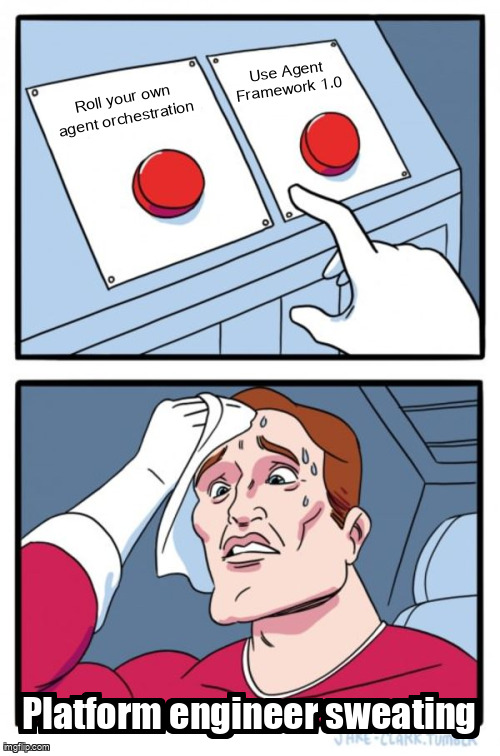
2) Microsoft Agent Framework 1.0: agents are officially “boring” now (good)
Agent Framework 1.0 shipped with stable APIs and long‑term support for both .NET and Python earlier this month, and it’s now clearly positioned as the default way to build multi‑agent systems on Azure (devblogs.microsoft.com).
Key engineering implications:
- Multi‑provider model support (OpenAI, MAI, others) reduces lock‑in.
- Built‑in orchestration and observability means fewer homegrown planners to maintain.
- Native fit with .NET 10 and
Microsoft.Extensions.AI.
Minimal .NET sketch
builder.Services.AddAgentFramework()
    .AddOpenAI()
    .AddAzureAIModels();
Yes, that’s it. The hard part is deciding what not to automate.
3) GitHub Copilot SDK: from “assistant” to embedded capability
The Copilot SDK entered public preview this month, exposing the same agent runtime used by Copilot Chat and Copilot CLI (github.blog).
What changed compared to earlier previews:
- Stable agent planning and tool invocation APIs.
- Designed to run inside your app, not as a sidecar dev tool.
- Language‑agnostic entry points that play well with Azure‑hosted backends.
Why .NET teams should care
- You can embed Copilot‑style agents into internal tools (CI triage, repo hygiene, support workflows).
- Latency is predictable because execution happens close to your code and data.
Rule of thumb If your agent needs:
- repo context → Copilot SDK
- business workflows → Agent Framework
- both → expect to compose them this year
4) Microsoft’s MAI models: cost pressure finally shows up
Microsoft’s in‑house MAI transcription, voice, and image models continue to ripple through the ecosystem, with coverage highlighting aggressive price‑performance positioning (techcrunch.com).
Even though the announcements landed earlier in April, the impact is becoming clear:
- Speech workloads see materially lower GPU cost per minute.
- Voice generation latency drops enough to enable real‑time agent scenarios.
- Azure AI Foundry treats MAI models as first‑class citizens, not “alternative providers.”
Engineering reality check You don’t have to switch today — but you should:
- Benchmark MAI vs OpenAI for steady‑state workloads.
- Revisit architectural decisions made when inference was the dominant cost.
5) .NET + AI readiness going into late 2026
While not brand‑new this week, the refreshed Generative AI for Beginners (.NET, v2) content reflects where Microsoft expects teams to be heading: agents, RAG patterns, and production diagnostics (devblogs.microsoft.com).
Action items for the next quarter
- Standardize on
Microsoft.Extensions.AIabstractions. - Budget time for agent observability (logs, traces, evals).
- Assume model churn; design for swap‑ability.
What to watch next
- Foundry Labs features graduating into core Azure AI services.
- Deeper Copilot SDK + Agent Framework convergence.
- More clarity on pricing tiers as MAI adoption grows.
In other words: less “prompt engineering”, more software engineering. Finally.
Further reading
- https://techcommunity.microsoft.com/blog/azure-ai-foundry-blog/whats-new-in-foundry-labs—april-2026/4509714
- https://devblogs.microsoft.com/agent-framework/microsoft-agent-framework-version-1-0/
- https://github.blog/changelog/2026-04-02-copilot-sdk-in-public-preview/
- https://techcrunch.com/2026/04/02/microsoft-takes-on-ai-rivals-with-three-new-foundational-models/
- https://devblogs.microsoft.com/dotnet/category/ai/