
GitHub Copilot SDK Lands for .NET: Embedding Agentic AI Without Building Your Own Brain
TL;DR
GitHub Copilot’s SDK is now in public preview, and .NET developers can embed the same agent runtime that powers Copilot CLI directly into their own apps. You get tool orchestration, streaming, permissions, and tracing out of the box—without inventing yet another “AI orchestration layer.” This is a meaningful shift from “AI helps me code” to “AI is part of my product.”
What actually shipped (and why it matters)
In the last couple of days, GitHub pushed fresh updates to the Copilot SDK repositories, including .NET naming cleanups, event model refinements, and updated NuGet packaging—clear signs that the public preview is stabilizing rather than stagnating. The SDK itself entered public preview on April 2, 2026, but this week’s commits and docs updates signal it’s ready for real experiments, not just demos (github.com).
The Copilot SDK exposes the same agentic runtime used by Copilot CLI and Copilot cloud agent. Instead of calling an LLM directly, you define:
- Agents (system prompt + behavior)
- Tools (functions, commands, APIs)
- Permissions (what the agent is allowed to do)
- Hooks (lifecycle interception points)
Copilot handles the rest: planning, tool selection, retries, and streaming responses.
For .NET engineers, the key takeaway is this: you’re no longer wiring prompts to models—you’re hosting an agent runtime.
Why this is different from “just another AI SDK”
Let’s be blunt. Most AI SDKs make you re‑solve the same hard problems:
- Multi‑turn state management
- Tool invocation protocols
- Safety boundaries and approval flows
- Streaming and cancellation
- Observability
The Copilot SDK bundles those concerns into a production‑tested loop GitHub already runs at scale (techcommunity.microsoft.com).
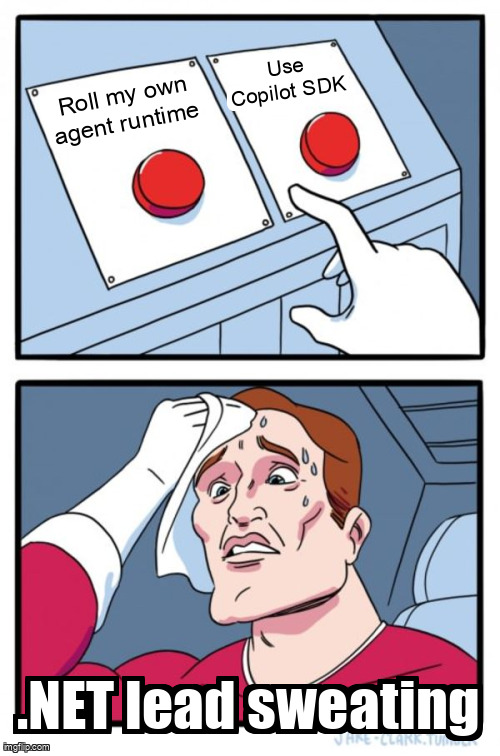
If you’ve ever shipped a “v1 agent” that turned into 2,000 lines of orchestration glue… you feel this meme in your soul.
.NET integration: what it looks like in practice
Installing the SDK is refreshingly boring (which is good):
dotnet add package GitHub.Copilot.SDK
A minimal agent setup in C# looks roughly like this:
var agent = new CopilotAgent(new AgentOptions
{
    SystemPrompt = "You are a release-notes assistant for a .NET team."
});

agent.Tools.Add("getCommits", GetCommitsAsync);
agent.Tools.Add("summarize", SummarizeAsync);

var response = await agent.RunAsync("Summarize changes since last tag.");
Behind the scenes, Copilot decides when to call getCommits, how to chain it with summarize, and whether permission checks apply. You don’t hard‑code that flow.
This is the subtle but important shift: you describe capabilities, not control flow.
Cost, latency, and deployment realities
A few pragmatic points engineers should know upfront:
-
Billing model:
Each prompt counts toward Copilot request quotas for subscribers. Enterprises can use BYOK (Bring Your Own Key) to route calls through Microsoft Foundry, OpenAI, or Anthropic models instead (github.blog). -
Latency:
Because the SDK supports streaming and incremental tool calls, perceived latency is often lower than raw LLM calls—users see progress instead of a frozen UI. -
Observability:
Built‑in OpenTelemetry support means traces flow into standard backends without custom plumbing. This matters the first time an agent does something… creative. -
Hosting:
The SDK runs anywhere .NET runs: ASP.NET, background workers, CLI tools, or containers on Azure App Service, Container Apps, or AKS.
When should you actually use this?
The Copilot SDK shines when:
- You’re embedding AI behavior into a product, not just augmenting dev workflows.
- You need tool‑heavy agents (file edits, APIs, CLIs).
- You care about governance and permissions, not “YOLO prompt execution.”
It’s probably overkill if all you need is a single text completion.
The bigger picture for Azure and .NET teams
Zooming out, this SDK pairs neatly with recent Azure and Microsoft AI moves: Microsoft is standardizing on agent runtimes + managed models, not one‑off prompt APIs. Copilot SDK becomes the control plane, while Foundry or other providers become the model plane.
For .NET engineers, this means fewer bespoke abstractions—and fewer late‑night “why did the agent do that?” debugging sessions. Fewer, not zero. Let’s stay realistic.
Further reading
- https://github.com/github/copilot-sdk
- https://github.blog/changelog/2026-04-02-copilot-sdk-in-public-preview/
- https://techcommunity.microsoft.com/blog/microsoftmissioncriticalblog/getting-started-with-github-copilot-sdk/4510059
- https://docs.github.com/en/copilot/how-tos/copilot-sdk
- https://github.blog/changelog/month/04-2026/