
Claude Opus 4.7 Lands in GitHub Copilot — Why .NET and Azure Engineers Should Care
TL;DR
Anthropic’s Claude Opus 4.7 is now generally available inside GitHub Copilot, bringing noticeably stronger multi‑step reasoning and more reliable agent-style execution. For .NET and Azure teams, this isn’t “just another model bump”: it changes how much logic you can safely hand to Copilot-powered agents, how you structure prompts and tools, and where latency and cost trade‑offs start to matter.
What actually shipped (and when)
On April 16, 2026, GitHub announced that Claude Opus 4.7 is rolling out as a generally available model option in GitHub Copilot. GitHub’s own testing highlights improved multi-step task performance and agentic execution reliability, especially for longer or more complex workflows. (github.blog)
This matters because Copilot is no longer “autocomplete with vibes.” With the Copilot SDK and agent runtime, Copilot can now plan, invoke tools, edit files, and execute commands programmatically inside your systems. In other words: execution is becoming the interface. (github.blog)
Why Opus 4.7 changes the calculus for engineers
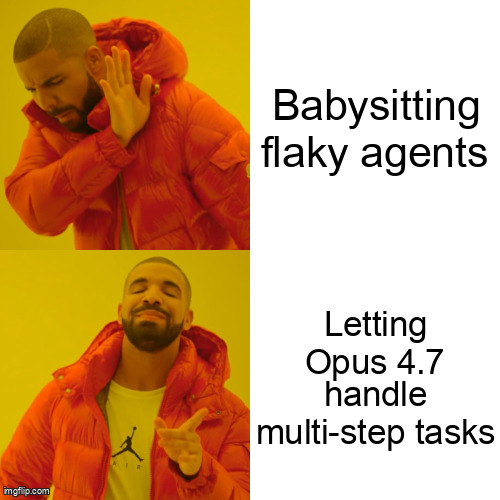
Previous-generation models were good at suggesting code but flaky at finishing multi-step tasks without babysitting. Opus 4.7 pushes that boundary:
-
More consistent reasoning chains
Fewer mid-task derailments when an agent has to analyze, plan, then act across several steps. This is critical if you’re letting Copilot refactor projects, generate tests, or operate on infra definitions. -
Better tool invocation discipline
Agents powered by the Copilot runtime rely on structured tools (often exposed via Model Context Protocol). Opus 4.7 is less likely to hallucinate tool usage or skip required inputs, which reduces guardrail code you have to write. (github.blog) -
Higher confidence automation
This is the first Copilot model update where “run it unattended in CI” feels less like a dare and more like an engineering decision.
Practical implications for .NET teams
1. Rethink how much logic lives in prompts
If you’re still stuffing business rules into giant prompts, you’re leaving reliability on the table. With stronger agent execution:
- Move rules into C# tools or services.
- Let Copilot plan when to call them instead of how they work.
This aligns well with modern .NET patterns: small, testable services + dependency injection + structured inputs.
2. Testing agents becomes non-optional
Opus 4.7 is better—but not magical. Treat agents like any other component:
- Write golden-path tests for agent workflows.
- Add timeouts and cancellation tokens around long-running tasks.
- Log tool invocations and intermediate decisions for post-mortems.
If this sounds like “distributed systems, but with vibes,” congratulations—you’re paying attention.
3. Latency and cost still matter
More capable reasoning often means more tokens and longer runs. Even though GitHub doesn’t expose per-token pricing inside Copilot, you’ll feel this indirectly:
- Slower feedback loops for large repos.
- More pressure to cache results or scope agent permissions tightly.
Design agents to do one job well, not everything everywhere all at once.
Azure angle: agents as first-class citizens
Microsoft’s broader direction is clear: agents are becoming a platform primitive, not a side feature. Azure AI Foundry and GitHub Copilot are converging on the same ideas—structured tools, governed execution, and identity-aware agents—even if they surface differently today. (github.blog)
For Azure-hosted .NET apps, this points toward:
- Agents triggered by events (deployments, queue messages, PR updates).
- Clear boundaries between LLM reasoning and cloud-side execution.
- Stronger governance around who (or what) an agent is allowed to touch.
What to do this week
- Enable Opus 4.7 in Copilot (if it’s not already default for you) and rerun a workflow that previously failed halfway through.
- Audit your Copilot prompts: anything longer than a screen probably wants to become a tool.
- Prototype one small agent—test generation, repo cleanup, or config validation—and measure how often it completes without intervention.
If your agent still goes off the rails, good news: at least now it’s doing so more intelligently.
Further reading
- https://github.blog/changelog/2026-04-16-claude-opus-4-7-is-generally-available/
- https://github.blog/ai-and-ml/github-copilot/the-era-of-ai-as-text-is-over-execution-is-the-new-interface/
- https://github.blog/changelog/2026-04-02-copilot-sdk-in-public-preview/
- https://github.blog/news-insights/company-news/build-an-agent-into-any-app-with-the-github-copilot-sdk/