
Microsoft–OpenAI’s Amended Deal Changes the Ground Rules for Azure AI Apps
TL;DR
Microsoft and OpenAI announced an amended partnership on April 27, 2026 that reshapes how OpenAI models are commercialized across clouds. For .NET and Azure engineers, the headline isn’t drama—it’s predictability: clearer rights, fewer surprises in APIs, and a stronger case for building long‑lived AI services on Azure without fearing sudden platform whiplash.
What actually changed (and why engineers should care)
On April 27, Microsoft published “The next phase of the Microsoft‑OpenAI partnership”, describing an amended agreement designed to add long‑term clarity and operational flexibility (blogs.microsoft.com). The announcement landed one day before TechCrunch reported that OpenAI also secured the ability to sell certain products on AWS, while Microsoft retained a revenue‑share and deep technical collaboration (techcrunch.com).
This combination matters because it answers a question many teams quietly worried about:
If OpenAI can run everywhere, is Azure still the “safe” place to build?
Short answer: yes—if you care about enterprise stability more than theoretical multi‑cloud purity.
The practical implications for Azure and .NET teams
1. Azure APIs are more stable, not less
Microsoft frames the amended deal as increasing predictability in how the two companies build and operate AI platforms (blogs.microsoft.com). For engineers, that translates into:
- Fewer sudden model removals or contract surprises
- More confidence that Azure OpenAI / Foundry APIs won’t churn mid‑project
- A clearer runway for compliance reviews and procurement approvals
This is boring news—in the best possible way.
2. Multi‑cloud doesn’t mean multi‑SDK chaos
Yes, OpenAI can now sell products on AWS. No, that doesn’t mean Azure loses relevance. Microsoft still focuses on platform‑level integration—identity, networking, policy, and governance wrapped around models.
For .NET teams, that means continuing to benefit from:
- Entra ID–based auth and managed identities
- First‑class Azure SDK support
- Tight integration with logging, metrics, and cost management
// Typical Azure-native setup still applies
builder.Services.AddAzureOpenAIClient(options =>
{
    options.Endpoint = new Uri(config["AzureOpenAI:Endpoint"]);
    options.Credential = new DefaultAzureCredential();
});
If your app already fits Azure’s security and ops model, nothing about this announcement forces a rewrite.
3. Cost and latency planning gets easier
One subtle but important signal: Microsoft emphasized long‑term operational clarity over exclusivity theatrics (blogs.microsoft.com). That suggests fewer “surprise” pricing or quota shifts tied to partnership politics.
For production systems, this means:
- More predictable capacity planning
- Fewer emergency migrations triggered by business news
- Better odds that latency optimizations (regions, caching, batching) remain valid over time
4. Azure is doubling down on the platform, not just models
TechCrunch notes that Microsoft still gains financially and technically, even as OpenAI expands elsewhere (techcrunch.com). Read between the lines and you’ll see Microsoft’s strategy: win on platform gravity.
For engineers, that’s a strong signal to:
- Invest in Azure AI Foundry–style orchestration and governance
- Lean into managed services instead of hand‑rolled glue code
- Treat models as interchangeable components, not your architecture’s foundation
Should you change anything this week?
Probably not—and that’s the point.
Do:
- Keep building against Azure AI services if you already are
- Abstract model access behind interfaces (you should’ve been doing this anyway)
- Track Azure roadmap updates for capacity and pricing signals
Don’t:
- Rush into a multi‑cloud rewrite “just in case”
- Assume Azure OpenAI is suddenly second‑class
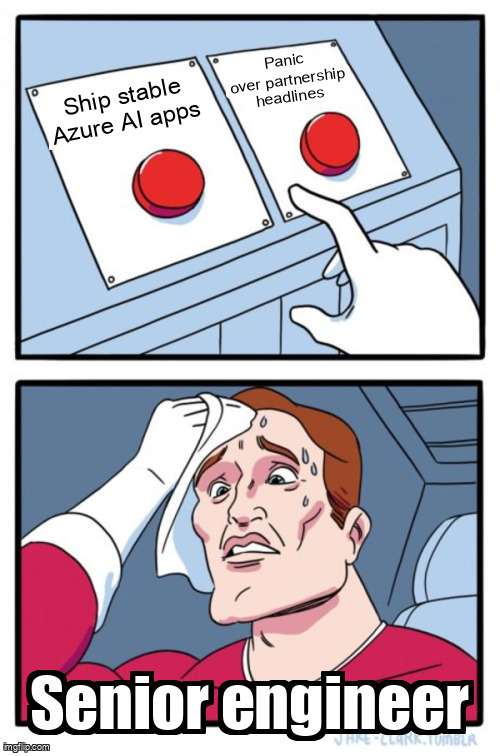
- Overreact to headlines without reading the actual agreement context
Bottom line
The April 27, 2026 announcement isn’t about who “won” the partnership—it’s about making AI platforms boring enough to trust. For .NET and Azure engineers shipping real products, that’s exactly what you want.
Stability is a feature. Microsoft just said it out loud.
Further reading
- https://blogs.microsoft.com/blog/2026/04/27/the-next-phase-of-the-microsoft-openai-partnership/
- https://techcrunch.com/2026/04/27/openai-ends-microsoft-legal-peril-over-its-50b-amazon-deal/
- https://azure.microsoft.com/en-us/blog/