
GPT‑5.5 Lands in Microsoft Foundry: What Changes for .NET & Azure Teams This Week
TL;DR
OpenAI’s GPT‑5.5 is rolling into Microsoft Foundry with enterprise-ready deployment, governance, and agent tooling. For .NET and Azure engineers, this is less about “bigger model” hype and more about predictable latency, clearer pricing envelopes, and first-class agent workflows that finally feel shippable.
Why this release matters (and why now)
Microsoft confirmed that GPT‑5.5 becomes generally available in Microsoft Foundry on May 5, 2026, positioning Foundry as the operational layer for agentic AI in Azure environments (azure.microsoft.com). While GPT‑5.4 introduced early enterprise agent support, GPT‑5.5 tightens the screws on multi-step reasoning, tool use, and long-running agents—the stuff that breaks first in production.
The timing is intentional: Foundry now bundles deployment, evaluation, governance, and cost controls into a single workflow, which directly addresses the “demo-to-prod cliff” many teams hit earlier this year.
What’s concretely new for engineers
1. More stable latency envelopes
GPT‑5.5 emphasizes latency predictability over peak benchmark scores. Microsoft frames this as “frontier intelligence with enterprise SLOs,” meaning fewer long-tail response spikes when agents chain calls or invoke tools (azure.microsoft.com).
Why you care:
If you’re building copilots inside APIs, background workers, or event-driven systems, this reduces the need for aggressive timeouts and retry gymnastics.
2. Foundry-native agent orchestration
Foundry isn’t just hosting the model—it’s acting as an agent runtime. You get:
- Tool registration and policy enforcement
- Evaluation hooks baked into deployments
- Auditing and governance aligned with Azure standards
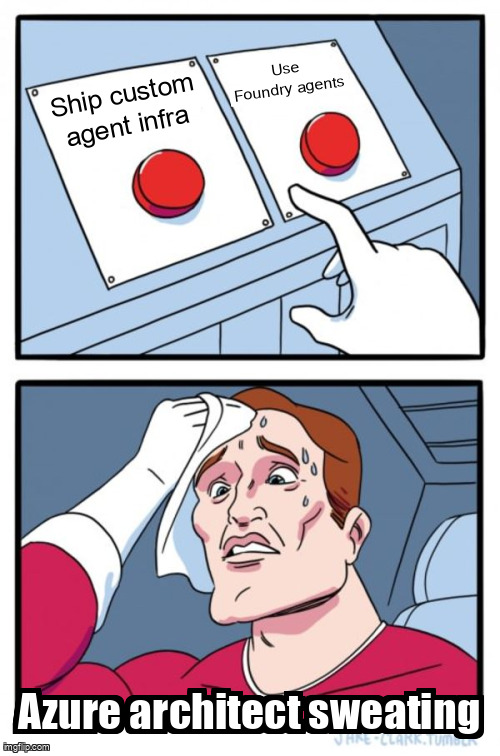
This moves agent logic out of ad-hoc app code and into a managed layer, which is a quiet but important architectural shift (techcommunity.microsoft.com).
3. Cost control is now a first-class feature
Microsoft is leaning hard on inference economics. Foundry exposes usage, evaluation results, and governance side-by-side, making it easier to answer the uncomfortable question: “Is this agent worth its tokens?”
While exact pricing still depends on region and capacity, Microsoft’s messaging is clear: optimize for fewer, smarter calls—not bigger prompts (azure.microsoft.com).
What this means for .NET developers
Integration path (today)
If you’re already using Azure OpenAI or the OpenAI .NET SDK, the jump is incremental:
dotnet add package Azure.AI.OpenAI
Then point your client at a Foundry-backed endpoint instead of a standalone deployment. The Azure OpenAI .NET libraries already support these patterns, so most changes are configuration, not rewrites (learn.microsoft.com).
Architectural takeaway
- Before: App code orchestrates prompts, tools, retries, and guardrails
- After: Foundry owns orchestration; your .NET code focuses on domain logic
This aligns nicely with ASP.NET Core, background services, and event-driven Azure workloads—less glue code, fewer “AI-specific” abstractions leaking everywhere.
Practical guidance before you upgrade
- Re-run evals, don’t assume parity. GPT‑5.5 improves reasoning, but that can change outputs in subtle ways. Foundry’s evaluation tooling exists for a reason.
- Watch agent loops. Better reasoning makes it easier to accidentally create very confident infinite loops. Set hard tool and step limits.
- Budget tokens per request, not per feature. GPT‑5.5 rewards tighter prompts and fewer hops.
The bottom line
GPT‑5.5 in Microsoft Foundry isn’t flashy—it’s operational. For teams shipping real software on .NET and Azure, this is the clearest signal yet that agentic AI is moving from experiments to infrastructure. Less prompt spelunking, more shipping.
If that sounds boring, congratulations: boring is exactly what production needs.
Further reading
- https://azure.microsoft.com/en-us/blog/openais-gpt-5-5-in-microsoft-foundry-frontier-intelligence-on-an-enterprise-ready-platform/
- https://techcommunity.microsoft.com/blog/azure-ai-foundry-blog/new-azure-open-ai-models-bring-fast-expressive-and-real%E2%80%91time-ai-experiences-in-m/4496184
- https://learn.microsoft.com/en-us/dotnet/api/overview/azure/ai.openai-readme
- https://learn.microsoft.com/en-us/dotnet/ai/