
GPT‑5.5 Instant Lands in Azure AI Foundry — What “chat‑latest” Changes for .NET Engineers
TL;DR
Microsoft started rolling out GPT‑5.5 Instant in Azure AI Foundry on May 6, 2026, exposed in the API as gpt-chat-latest. It’s tuned for lower latency chat workloads while inheriting reasoning improvements from the GPT‑5.x line. For .NET teams, the big deal is simpler model targeting, faster responses, and fewer redeployments when Microsoft updates the underlying model.
What actually shipped (and when)
On May 6, 2026, the Azure AI Foundry team announced that OpenAI’s GPT‑5.5 Instant is rolling out under a stable alias called gpt-chat-latest. The model builds on GPT‑5.4 / GPT‑5.3‑chat and focuses on measurable latency improvements for interactive chat scenarios while keeping quality upgrades from the newer generation. (techcommunity.microsoft.com)
This is not just “another model SKU.” The important shift is the alias-first approach:
- You target
gpt-chat-latest - Microsoft upgrades what’s behind that alias over time
- Your app keeps running without redeploying or reconfiguring model IDs
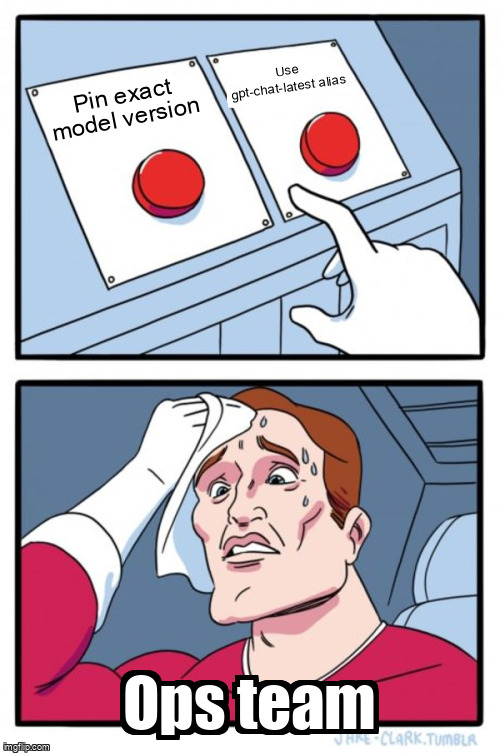
If you’ve been pinning exact model versions and scheduling quarterly “AI dependency upgrades,” this is Microsoft nudging you toward something closer to evergreen infrastructure.
Why this matters for engineers shipping on .NET
1. Latency wins for chat-heavy apps
GPT‑5.5 Instant is explicitly positioned for chat and conversational flows. While Microsoft hasn’t published exact millisecond benchmarks yet, they call out “measurable gains” over prior chat models. In practice, that usually means:
- Faster token first-byte times
- Smoother streaming responses in UI
- Less need for client-side “typing…” hacks
If you’re building copilots in Blazor, ASP.NET, or desktop apps, lower latency is the difference between “this feels smart” and “is it frozen?” (techcommunity.microsoft.com)
2. The chat-latest alias changes deployment strategy
Previously, many teams hard‑coded model versions like gpt-5.4-chat to avoid surprise behavior changes. With gpt-chat-latest, Microsoft is signaling:
“We’ll handle safe upgrades; you focus on features.”
That has real implications:
Pros
- Fewer redeploys just to bump model versions
- Easier multi‑environment parity (dev/test/prod)
- Cleaner config (one model name everywhere)
Cons
- You must invest in evaluation and regression tests
- Output drift is now a when, not an if
If you already use evaluation pipelines in Foundry, this trade‑off makes sense. If not, you’ll want to start.
3. Cost predictability (the quiet benefit)
While the announcement doesn’t publish new pricing tables, “Instant” models historically sit in the chat‑optimized cost band rather than reasoning‑heavy tiers. That usually means:
- Lower per‑token cost than deep reasoning models
- Better cost/latency ratio for high‑volume chat
For SaaS teams watching Azure OpenAI bills like hawks, this is the model class you want fronting user‑facing chat, with heavier models reserved for background tasks. (techcommunity.microsoft.com)
Using GPT‑5.5 Instant from .NET (today)
If you’re already on Azure AI Foundry or Azure OpenAI, the change is refreshingly small.
Example: C# with Azure.AI.OpenAI
var client = new OpenAIClient(
    new Uri(endpoint),
    new AzureKeyCredential(apiKey));

var response = await client.GetChatCompletionsAsync(
    deploymentOrModelName: "gpt-chat-latest",
    new ChatCompletionsOptions
    {
        Messages =
        {
            new ChatMessage(ChatRole.System, "You are a helpful assistant."),
            new ChatMessage(ChatRole.User, "Summarize this PR in one paragraph.")
        }
    });

var reply = response.Value.Choices[0].Message.Content;
No new SDK required. No new auth flow. Just a different model identifier.
Practical guidance before you flip the switch
- Add lightweight evals
- Snapshot representative prompts
- Compare responses weekly
- Alert on large semantic drift
- Segment workloads
- UI chat →
gpt-chat-latest - Complex reasoning → pinned GPT‑5.x reasoning model
- UI chat →
- Log model metadata
- Store
model_versionfrom responses when available - Helps explain behavior changes later
- Store
- Communicate with product
- “The AI got better” can also mean “the AI answers differently”
The bigger picture
GPT‑5.5 Instant isn’t flashy, but it’s strategic. Microsoft is steadily pushing Azure AI toward managed, continuously improving primitives rather than static model SKUs. For .NET and Azure teams, that means less time babysitting model upgrades—and more time shipping features users actually notice.
And yes, your CI pipeline now owns some of that responsibility. Welcome to 2026.
Further reading
- https://techcommunity.microsoft.com/category/azure-ai-foundry/blog/azure-ai-foundry-blog