
Microsoft Agent Framework 1.0 Lands: .NET Finally Gets a First‑Class Way to Ship AI Agents
TL;DR
Microsoft’s Agent Framework for .NET quietly crossed a big threshold in early May 2026: it’s now a production‑ready SDK built on Microsoft.Extensions.AI, designed for real agents (tools, memory, orchestration), not just chatbots. If you’re shipping AI features on .NET or Azure, this changes how you structure apps, reason about cost, and wire models into real workflows.
What actually shipped (and why it matters)
In a series of posts culminating with “Microsoft Agent Framework – Building Blocks for AI Part 3”, the .NET team laid out the final piece of their AI stack: a first‑party agent runtime that sits cleanly on top of .NET 10 and Azure AI services (devblogs.microsoft.com).
This is not a preview toy. The Agent Framework:
- Builds directly on
IChatClientfrom Microsoft.Extensions.AI (MEAI). - Supports tool calling, multi‑turn memory, and graph‑based workflows.
- Targets production scenarios, not demos.
If you’ve been stitching together Semantic Kernel, custom orchestration glue, and retry logic at 2 a.m., this is Microsoft acknowledging your pain.
From “chatbot” to “agent” (the practical difference)
A chatbot:
- Takes input
- Calls a model
- Returns text
An agent:
- Interprets intent
- Decides which tools to call
- Executes actions
- Evaluates results
- Repeats until the task is done
The Agent Framework formalizes this loop in a way that fits naturally into .NET dependency injection and hosting patterns (devblogs.microsoft.com).
That means agents can:
- Call internal APIs
- Query databases
- Orchestrate Azure resources
- Maintain state across conversations
All without inventing a bespoke framework per project.
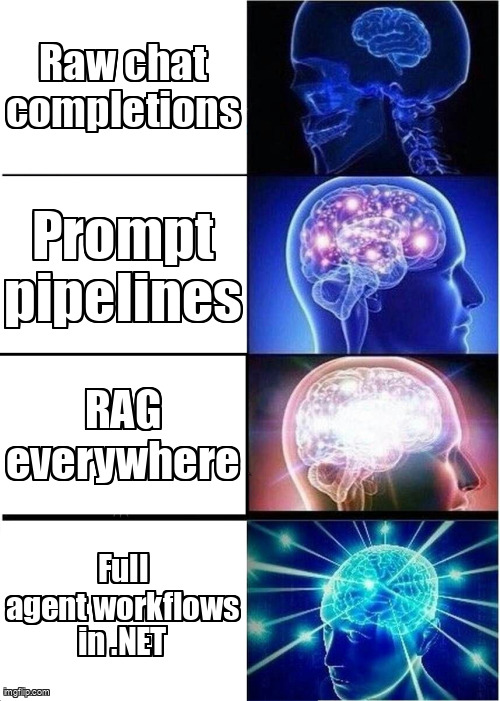
The stack, end to end
Microsoft is now very explicit about the layers:
-
Microsoft.Extensions.AI
One abstraction for Azure OpenAI, OpenAI, local models, and more (devblogs.microsoft.com). -
Microsoft.Extensions.VectorData
RAG and semantic search without binding yourself to a single vector DB. -
Microsoft Agent Framework
The control plane for reasoning, tools, and workflows.
Think of it as ASP.NET Core for agents—opinionated, boring (in a good way), and designed to scale.
Cost and latency implications
This is where engineers should lean forward.
Cost
- Agents encourage more model calls, not fewer.
- Tool calls and retries add tokens.
- MEAI middleware makes it easier to add rate limits, caching, and telemetry early, before finance asks awkward questions.
Latency
- Agent loops are sequential by default.
- Graph‑based workflows let you parallelize steps when possible.
- Azure OpenAI deployments close to your app still matter—region choice is no longer an afterthought.
In other words: agents are powerful, but they punish sloppy design.
A minimal agent in C#
Here’s what “hello, agent” looks like today:
dotnet add package Microsoft.Agents.AI
using Microsoft.Agents.AI;

var agent = new AgentBuilder()
    .WithName("OpsAgent")
    .WithInstructions("Help diagnose production issues.")
    .Build();

await agent.RunAsync("Check the last failed deployment.");
Under the hood, this plugs into the same MEAI abstractions you already use for chat completions, which means model swapping is configuration, not surgery (devblogs.microsoft.com).
Azure integration: boring by design (good!)
Nothing here forces a new control plane.
- Identity:
DefaultAzureCredential - Hosting: ASP.NET, Workers, Functions
- Models: Azure OpenAI, Foundry, or local
That “boring” story is intentional—and very different from the bespoke stacks most teams built in 2024–2025.
Should you adopt this now?
Yes, if:
- You’re already on .NET 10
- You’re building workflows that do things, not just answer questions
- You care about maintainability more than novelty
Wait, if:
- You only need single‑turn chat
- Your org isn’t ready to reason about agent governance and observability
Microsoft’s direction is clear: agents are no longer experimental infrastructure. They’re becoming standard application components.
Further reading
- https://devblogs.microsoft.com/dotnet/microsoft-agent-framework-building-blocks-for-ai-part-3/
- https://devblogs.microsoft.com/dotnet/dotnet-ai-essentials-the-core-building-blocks-explained/
- https://learn.microsoft.com/en-us/dotnet/ai/overview
- https://azure.microsoft.com/en-us/updates/
- https://blogs.microsoft.com/on-the-issues/2026/05/07/the-state-of-global-ai-diffusion-in-2026/