SAP Sapphire 2026 Puts “Agentic ERP” on Azure—What That Actually Means for .NET Engineers
TL;DR:
At SAP Sapphire on May 12, 2026, Microsoft and SAP announced deeper agentic AI integration on SAP on Azure, positioning Azure as the execution layer for “autonomous enterprise” scenarios. For .NET and Azure engineers, this isn’t marketing fluff: it translates into concrete integration points (Azure AI, agents, data foundations), new cost/latency considerations, and a clearer path to shipping AI that can act, not just chat. (azure.microsoft.com)
The one update that matters
The Sapphire announcement doubles down on agentic intelligence embedded in ERP workflows, powered by Azure’s AI-first cloud and SAP’s business context. Microsoft frames this as moving AI from experimentation to everyday impact—with agents that understand enterprise data, processes, and policies. In practice, Azure becomes the place where these agents run, reason, and integrate. (azure.microsoft.com)
Why this matters for engineers shipping on .NET and Azure: ERP is where the data gravity lives. If agents can safely act there, your apps can finally close the loop from insight → decision → action.
What changed (and what didn’t)
✅ What’s new
- Agentic patterns, not just copilots. The focus is on agents that execute multi-step workflows across SAP systems, grounded in business semantics and governed by enterprise controls. (azure.microsoft.com)
- Azure as the agent runtime. Azure is positioned as the AI-first commercial cloud to host these agents, integrating identity, data, and observability.
- Unified data foundation. The announcement emphasizes a shared data layer so agents can reason with context (finance, supply chain, HR) instead of brittle prompts.
❌ What’s not
- This is not a brand-new SDK drop with a single magic API.
- It’s not replacing custom integrations overnight—existing SAP + Azure patterns still apply.
Practical implications for .NET & Azure teams
1) Architecture: agents need first-class governance
If your .NET services integrate with SAP today, plan for agent orchestration rather than one-off calls.
- Identity: Expect heavy use of Entra ID and role-based access—agents acting on behalf of users need auditable permissions.
- Observability: Treat agents like production services. Azure Monitor + Application Insights aren’t optional anymore.
// Pseudocode: wrapping an agent action with telemetry
using var activity = Telemetry.StartActivity("sap.agent.execute");
await agent.ExecuteAsync(new AgentContext {
    User = userContext,
    SapScope = SapScopes.ProcureToPay
});
2) Cost & latency: ERP-grade expectations apply
Agents that act cost more than agents that chat.
- Latency: ERP workflows are synchronous in users’ minds—even if agents are async under the hood. Budget for Azure region proximity to SAP workloads.
- Cost: Agent loops (plan → act → verify) can multiply token and compute usage. Design guardrails early.
Rule of thumb: if a workflow touches finance or supply chain, assume production-grade SLAs and budgets, not hackathon pricing.
3) Integration steps you can start now
You don’t need to wait for a single “Agentic ERP SDK.”
- Harden your SAP ↔ Azure integration
- Clean up APIs, events, and data contracts.
- Introduce agent boundaries
- Define what an agent can and cannot do (per workflow).
- Ship with humans in the loop
- Autonomous doesn’t mean unsupervised—especially in ERP.
Why this is a big deal (quietly)
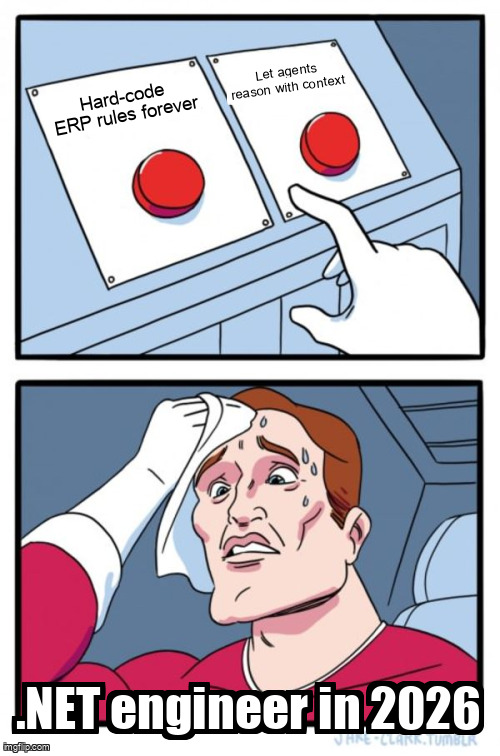
SAP and Microsoft aren’t promising sci‑fi autonomy. They’re doing something more disruptive: normalizing agents inside the most conservative software category on earth—ERP. If that sticks, the expectation for enterprise apps shifts fast.
For .NET and Azure engineers, the takeaway is simple:
- Start designing action-capable AI.
- Treat agents as production services, not demos.
- Expect Azure to be the glue between business data and AI execution.
ERP just became an AI runtime. Whether that excites or terrifies you… probably both.
Further reading
- https://azure.microsoft.com/en-us/blog/advancing-enterprise-ai-new-sap-on-azure-announcements-from-sap-sapphire-2026/
- https://azure.microsoft.com/en-us/blog/product/azure-ai/
- https://blogs.microsoft.com/blog/
- https://techcommunity.microsoft.com/