
GPT‑5.5 Lands in Microsoft Foundry — What “GA” Actually Means for .NET and Azure Teams
TL;DR
OpenAI’s GPT‑5.5 is now generally available (GA) in Microsoft Foundry on Azure. For engineers shipping production apps on .NET and Azure, this isn’t just a model bump: it comes with enterprise deployment guarantees, predictable billing, and first‑class integration into Azure’s AI control plane. Translation: fewer previews, more SLAs, and less “don’t ship this yet” anxiety.
What shipped (and why this one matters)
Microsoft announced that OpenAI’s GPT‑5.5 is generally available in Microsoft Foundry, positioning it as an enterprise‑ready frontier model for teams building agents and AI apps on Azure. GA status is the quiet but crucial signal: supported APIs, regional availability, compliance alignment, and a stability bar suitable for production workloads. (azure.microsoft.com)
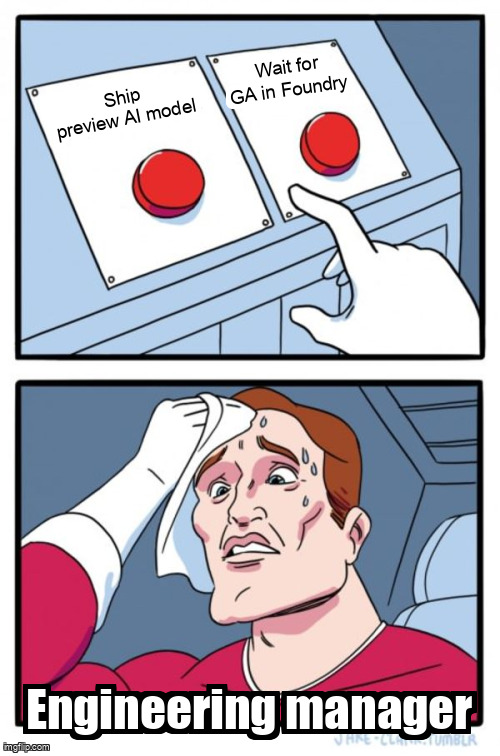
If you’ve been stuck explaining to compliance why your “preview” dependency is totally fine (it wasn’t), this is your exit ramp.
Microsoft Foundry ≠ “just another endpoint”
Foundry is Microsoft’s unified surface for deploying and operating advanced AI models on Azure—governance, networking, identity, and observability included. With GPT‑5.5 joining the GA roster, you can treat it like any other Azure workload: private networking, RBAC, metrics, and cost controls come standard. (azure.microsoft.com)
Why engineers care:
- Enterprise guardrails: Azure AD auth, private endpoints, policy enforcement.
- Operational parity: logs, metrics, and alerts alongside your app services.
- Longevity: GA models come with deprecation policies instead of surprise removals.
Cost, latency, and capacity (the practical bits)
Microsoft hasn’t published a single magic number for “GPT‑5.5 latency,” but two things are clear:
- Capacity planning is now real. GA implies capacity commitments and scaling guidance you can plan against, rather than “best effort” preview behavior. (azure.microsoft.com)
- Compute pressure is industry‑wide. OpenAI leadership continues to highlight constrained compute amid surging demand—one reason Azure integration and capacity guarantees matter for customers. (bloomberg.com)
Engineering takeaway: expect more predictable performance profiles than previews, but still budget and load‑test. Frontier models are powerful, not magical.
Getting started from .NET (conceptual example)
If you’re already using Azure’s AI SDKs, adoption should feel familiar. At a high level:
// Pseudocode – API names may vary by SDK version
var client = new AzureAiClient(
    endpoint: new Uri("<your-foundry-endpoint>"),
    credential: new DefaultAzureCredential());

var response = await client.Chat.Completions.CreateAsync(
    model: "gpt-5.5",
    messages: new[]
    {
        new ChatMessage("system", "You are a helpful assistant."),
        new ChatMessage("user", "Summarize this PR in plain English.")
    });

Console.WriteLine(response.Choices[0].Message.Content);
What’s different vs. previews is where this runs: inside your Azure boundary, with the same identity, networking, and monitoring story as the rest of your stack.
Migration notes if you’re on older models
- API shape: Expect minimal changes if you’re already using Azure OpenAI‑style chat completions.
- Behavioral drift: Even with compatibility promises, re‑run evals. Newer models can be more correct—and occasionally more verbose.
- Cost controls: Set quotas and alerts early. GA makes it easier to scale; it doesn’t make runaway prompts cheaper.
The bigger picture
Microsoft is clearly steering advanced OpenAI models toward Foundry as the default enterprise home, aligning with its broader push to make Azure the control plane for production AI. With GPT‑5.5 GA, the message to .NET and Azure teams is simple: this is the supported path—use it.
Not flashy. Very shippable.
Further reading
- https://azure.microsoft.com/en-us/blog/content-type/announcements/
- https://azure.microsoft.com/en-us/solutions/ai/
- https://www.bloomberg.com/news/articles/2026-05-15/openai-may-raise-more-money-as-compute-crunch-deepens-cfo-says
- https://azure.microsoft.com/en-us/blog/