
Azure OpenAI’s Foundry Update Lands — and It Changes How .NET Apps Talk to Models
TL;DR
A May 18, 2026 update to Azure OpenAI in Microsoft Foundry quietly reshapes the developer experience: model versioning is more explicit, auto‑upgrade behavior is clearer, and the v1 API contract is now the long‑term path forward. For .NET and Azure engineers, this affects how you deploy, upgrade, and budget for models—not just which model you call.
What actually shipped (May 18–19, 2026)
Microsoft updated the “What’s new in Azure OpenAI in Microsoft Foundry Models (classic)” documentation with clarifications that matter in production environments, especially around model lifecycle and versioning (learn.microsoft.com).
At the same time, the Azure OpenAI v1 API lifecycle guidance was refreshed, reinforcing that v1 is no longer “new”—it’s the stability anchor going forward (learn.microsoft.com).
This isn’t a flashy launch. It’s more dangerous than that: it’s a behavioral change.
The core change: model upgrades are now your problem (by design)
Foundry makes a clean distinction between:
- Model family (for example,
gpt-4o-mini) - Model version (date-stamped, region-scoped, and eventually retired)
If your deployment uses:
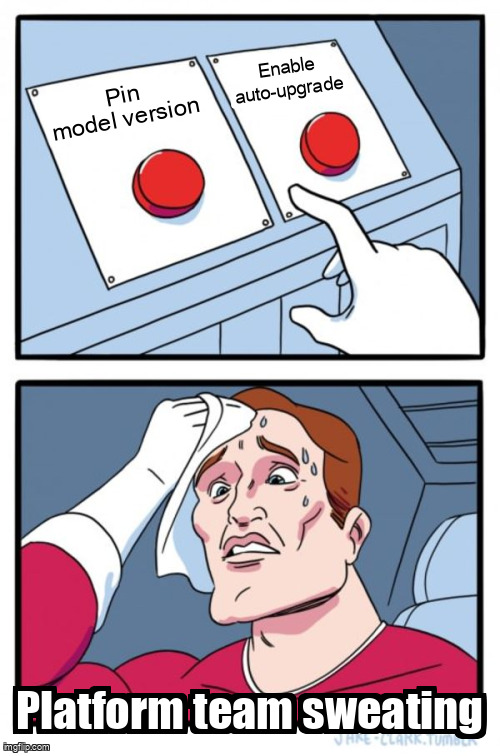
- Automatic version upgrades, Foundry will move you forward within policy when a new default version appears.
- Pinned versions, you keep control—but you also inherit responsibility when retirement dates approach.
Microsoft now documents this lifecycle more explicitly, including overlap windows and notifications (learn.microsoft.com).
Why this matters
Many teams assumed “Azure will just keep it working.” That assumption is no longer safe.
The v1 API is now the contract you should target
The Azure OpenAI v1 API removes api-version query churn and standardizes auth and routing across Foundry-hosted models (learn.microsoft.com).
Practical implications for .NET engineers
If you’re still doing this:
var client = new OpenAIClient(
    new Uri(endpoint),
    new AzureKeyCredential(key),
    new OpenAIClientOptions { Version = OpenAIClientOptions.ServiceVersion.V2024_07_01 });
You should plan to move toward:
- v1 endpoints
- Version-agnostic client configuration
- Deployment-level version control instead of code-level switches
This reduces redeploys when models roll and aligns better with multi‑region failover.
Cost & latency: fewer surprises, but only if you read the fine print
Foundry’s updated docs emphasize that price and performance are version-specific, even within the same model family (learn.microsoft.com).
Two consequences:
-
Auto-upgrades can change your bill
A newer default version may have different token pricing or throughput characteristics. -
Latency tuning now starts at deployment time
Choosing Global Standard vs Provisioned deployments has bigger impact than client-side retries.
If you’re on provisioned throughput, double-check that your reservation SKU matches the deployment type, or you may silently fall back to hourly pricing (learn.microsoft.com).
Integration checklist for Azure + .NET teams
Before your next sprint ends, do this:
- Audit deployments
- List model families and versions.
- Note retirement dates.
- Decide your upgrade strategy
- Auto-upgrade for internal tools.
- Pinned versions for regulated workloads.
- Align code with v1
- Remove hard-coded API versions.
- Treat model choice as configuration, not code.
- Set alerts
- Subscription owner notifications are documented—but only helpful if someone reads them.
Why this update matters more than it looks
This Foundry update is Microsoft signaling maturity:
- Fewer surprises.
- Clearer contracts.
- More responsibility pushed to engineering teams.
In other words: you now run AI like any other production dependency. No magic, no vibes, no “it worked yesterday.”
Which, honestly, is progress.
Further reading
- https://learn.microsoft.com/en-us/azure/foundry-classic/openai/whats-new
- https://learn.microsoft.com/en-us/azure/foundry/openai/api-version-lifecycle
- https://learn.microsoft.com/en-us/azure/foundry/openai/concepts/model-retirements
- https://learn.microsoft.com/en-us/azure/foundry/openai/how-to/working-with-models
- https://learn.microsoft.com/en-us/azure/foundry-classic/openai/concepts/provisioned-migration