
Sunday Signal: Azure AI Gets Cheaper, Copilot Gets Smarter, and .NET Keeps Abstracting the Chaos
TL;DR
A relatively quiet late‑May week still delivered meaningful signals for engineers shipping on .NET and Azure: GitHub Copilot shipped incremental but practical upgrades, .NET’s AI abstraction story continues to solidify, and Azure’s long‑term AI infrastructure bets are increasingly about cost‑efficient inference rather than flashier models. If you’re planning 2025–2026 roadmaps, this is a good week to think about latency, provider flexibility, and operational cost controls.
1) GitHub Copilot: Fewer Fireworks, More Fit‑and‑Finish
GitHub published a fresh Copilot update on May 22, 2026, focusing less on splashy features and more on day‑to‑day developer ergonomics (github.blog). The theme: Copilot is settling into its role as a background productivity layer, not a novelty.
What matters for .NET and Azure engineers:
- Lower friction loops: Faster suggestions and fewer context switches matter more than “one more agent.”
- Model choice fades into the background: Copilot increasingly abstracts model selection, which mirrors what we’re seeing in Azure and .NET APIs.
- Enterprise caution remains warranted: Recent policy updates (earlier this spring) around data usage mean teams should still verify Copilot Business / Enterprise settings before wider rollout.
Takeaway: If Copilot already fits your workflow, keep it on. If it doesn’t, this week didn’t change the calculus—but it did reinforce that GitHub is optimizing for reliability over hype.
2) .NET’s AI Abstraction Layer Is Quietly Becoming the Default
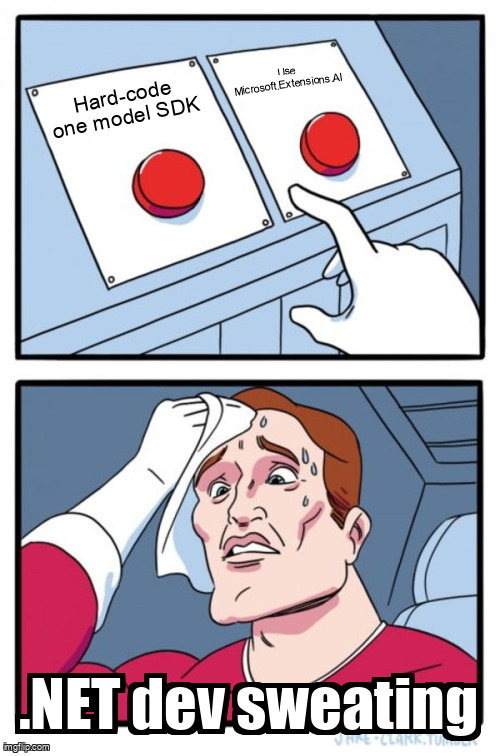
Microsoft’s ongoing work around Microsoft.Extensions.AI continues to age well, even without a brand‑new announcement this weekend. The most recent .NET AI Essentials guidance (updated and recrawled this week) reinforces a clear direction: one API surface, many model providers (devblogs.microsoft.com).
Why this matters right now:
- You can swap between Azure OpenAI, local models, or third‑party providers with minimal code churn.
- Built‑in hooks for telemetry, middleware, and DI align cleanly with ASP.NET and minimal APIs.
- This abstraction is turning into a hedge against fast‑moving model and pricing changes.
builder.Services.AddChatClient()
    .UseAzureOpenAI(options =>
    {
        options.Endpoint = new Uri(endpoint);
        options.ApiKey = key;
        options.DeploymentName = "gpt-4o-mini";
    });
Takeaway: Even if you’re not “doing AI” yet, adopting these abstractions now is a low‑risk future‑proofing move.
3) Azure’s AI Story Is About Inference Economics, Not Model Bragging
While no brand‑new Azure AI launch landed between May 22–24, 2026, Microsoft’s recent messaging continues to converge on a consistent theme: inference efficiency at scale. Earlier 2026 disclosures around Azure’s AI infrastructure and first‑party silicon (like Maia) are still the backdrop for current platform decisions (blogs.microsoft.com).
For engineers, this shows up indirectly:
- More SKUs optimized for throughput and predictable latency.
- Pricing pressure shifting from “which model?” to “how many tokens per dollar?”
- Greater emphasis on batching, caching, and streaming responses in Azure AI services.
Takeaway: Expect Azure APIs to keep nudging you toward patterns that reduce per‑request cost—sometimes subtly, sometimes via pricing.
4) What Wasn’t Announced (and Why That’s Useful)
No major late‑May bombshells from Microsoft Build, Azure AI Foundry, or OpenAI partnerships this weekend—and that’s actually useful signal.
- Platform teams appear to be stabilizing after a fast Q1/Q2.
- Documentation, SDK polish, and operational guidance are getting more attention than launches.
- This is typically the window where preview features quietly become “safe enough” for production pilots.
Takeaway: If you’ve been waiting for the dust to settle before moving an AI prototype into a real .NET service, this is a reasonable moment.
Looking Ahead: 2025–2026 Readiness Checklist
As we head into summer:
- ✅ Prefer abstractions over direct SDKs (Copilot, Azure OpenAI, local models all change fast).
- ✅ Track inference cost per request, not just model quality.
- ✅ Plan for model churn—assume today’s default won’t be next year’s.
- ✅ Keep an eye on Azure region availability and quotas; infra decisions increasingly affect app architecture.
In short: fewer fireworks this week, but plenty of groundwork being poured. Sometimes the most important AI news is that things are getting… boring—in the best possible way.
Further reading
- https://github.blog/ai-and-ml/github-copilot/
- https://devblogs.microsoft.com/dotnet/dotnet-ai-essentials-the-core-building-blocks-explained/
- https://blogs.microsoft.com/blog/2026/01/26/maia-200-the-ai-accelerator-built-for-inference/