
The Week AI Got More Agentic (and a Bit More Practical) for .NET & Azure Devs
TL;DR
Late May didn’t bring a single “drop everything” launch—but it did confirm a clear direction: agentic AI is moving from demos to developer-grade tooling. For .NET and Azure engineers, that means more standardized APIs, more control over models and costs, and fewer excuses to keep everything as a glorified chat box.
1) .NET’s Agent Story Is Solidifying (Quietly, but Clearly)
The most developer-relevant signal this week isn’t a headline—it’s momentum. Microsoft’s Agent Framework for .NET continues to mature, with recent guidance focusing on production patterns: tool calling, memory, durable execution, and orchestration that fits naturally with ASP.NET, background services, and Azure Functions (devblogs.microsoft.com).
What matters in practice:
- Agents are first-class citizens, not ad‑hoc prompt loops.
- The framework leans on familiar .NET primitives (DI, middleware, logging).
- It’s designed to scale out, not just chat back.
Takeaway: If your AI feature roadmap still assumes “one request = one prompt,” you’re already behind.
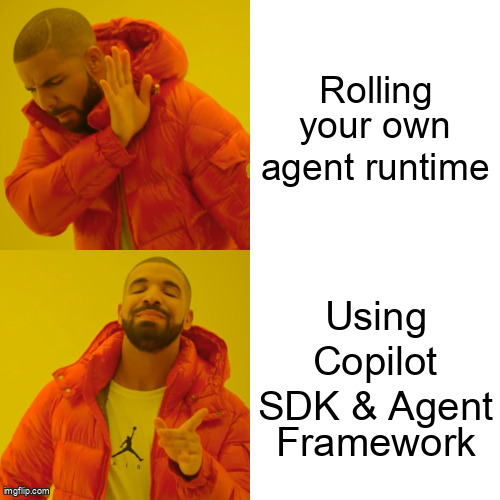
2) GitHub Copilot SDK: From Assistant to Embedded Runtime
GitHub’s Copilot SDK, now in public preview, keeps showing up in real engineering conversations—and that’s the point. It exposes the same agent runtime used by Copilot itself: tool invocation, streaming, multi-turn sessions, and file ops, including a supported .NET package (github.blog).
Why .NET/Azure engineers should care:
- You don’t need to invent an orchestration layer.
- Agents can live inside your app—not just in the IDE.
- It pairs well with Azure-hosted services or internal tooling.
Latency & cost angle: Centralized agent runtimes reduce duplicated glue code (and duplicated tokens). That adds up.
3) BYOK and Local Models Are No Longer Niche
A subtle but important shift: Copilot CLI now supports BYOK and local models (github.blog). This reinforces a broader trend across Microsoft’s AI stack—developers are being given real choices about where inference happens.
Implications:
- Sensitive workloads can stay local or sovereign.
- Cost optimization becomes an engineering decision, not just a finance one.
- Hybrid patterns (local + Azure) are becoming normal.
Preview what’s next: Expect Azure-hosted agent services to increasingly assume heterogeneous model backends by default.
4) Proof from the .NET Runtime Team: Agents at Scale
If you’re skeptical, the .NET Runtime team has been unusually candid about their experience using Copilot Coding Agent in production engineering workflows. After months of usage, the data shows measurable productivity gains—but only when guardrails, reviews, and scoped permissions are in place (devblogs.microsoft.com).
Key lessons engineers should internalize:
- Agents amplify good engineering habits—and bad ones.
- Reviews and observability matter more than model choice.
- “Autonomous” still means “accountable.”
5) Infrastructure Still Matters (Even If You Don’t Touch It)
Microsoft’s late‑April update on its OpenAI partnership emphasized long‑term capacity planning and operational clarity, not shiny features (blogs.microsoft.com). Translation for developers: Azure is betting heavily on predictable, large‑scale inference economics.
Why that matters to you:
- More predictable pricing models are likely.
- Latency variance should continue to improve.
- Agent-heavy architectures become safer to ship.
What to Do This Coming Week
For 2026‑ready teams:
- Audit your AI features: Are they prompt-first or agent-first?
- Standardize now: Pick Agent Framework or Copilot SDK before entropy wins.
- Plan cost controls: BYOK/local isn’t optional anymore.
- Design for reviewability: Logs, traces, and human checkpoints.
AI in the Microsoft ecosystem isn’t slowing down—it’s settling in. And that’s usually when the real engineering work begins.
Further reading
- https://devblogs.microsoft.com/dotnet/microsoft-agent-framework-building-blocks-for-ai-part-3/
- https://github.blog/changelog/2026-04-02-copilot-sdk-in-public-preview/
- https://github.blog/changelog/2026-04-07-copilot-cli-now-supports-byok-and-local-models/
- https://devblogs.microsoft.com/dotnet/ten-months-with-cca-in-dotnet-runtime/
- https://blogs.microsoft.com/blog/2026/04/27/the-next-phase-of-the-microsoft-openai-partnership/