
GitHub Copilot’s One‑Million‑Token Context Changes How You Work with Large .NET Codebases
TL;DR
GitHub Copilot now supports up to a one‑million‑token context window with configurable reasoning levels across VS Code, Visual Studio, the Copilot CLI, and the Copilot app. For .NET and Azure engineers, this is less “wow, big number” and more “finally, my monorepo fits in the room.” Expect better cross‑project refactors, more reliable architectural answers, and—yes—new cost and latency trade‑offs you’ll want to manage deliberately. (github.blog)
What actually shipped (and where)
On June 4, 2026, GitHub rolled out larger context windows and adjustable reasoning levels for Copilot. The headline feature is support for context windows up to one million tokens, available now in VS Code, Visual Studio, Copilot CLI, and the Copilot app, with more surfaces coming. (github.blog)
Two important clarifications for engineers:
- This isn’t just about “longer prompts.” Copilot can now hold significantly more of your repository, docs, and conversation state at once.
- Reasoning levels are configurable, letting you trade speed vs. depth depending on the task.
Why this matters for .NET and Azure teams
1) Whole‑solution understanding (at last)
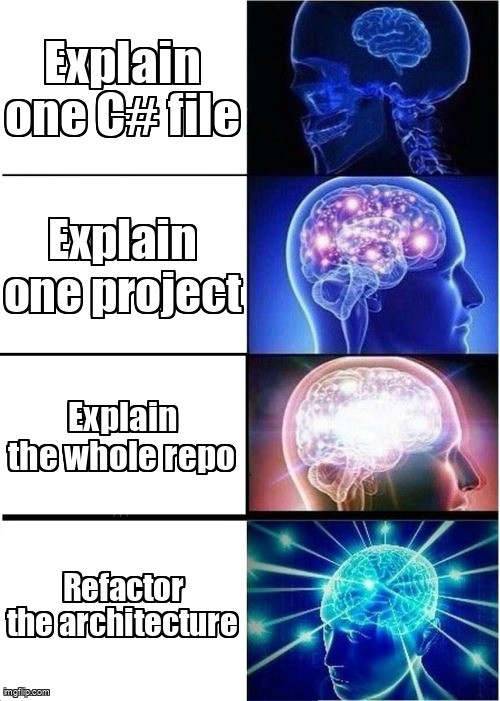
If you maintain a sizable .NET solution—multiple projects, shared libraries, Terraform/Bicep, pipelines, and docs—previous context limits meant Copilot frequently “forgot” key pieces. With a million tokens, Copilot can now:
- Track cross‑project dependencies in large solutions.
- Reason about end‑to‑end request flows (API → service → data → background workers).
- Propose refactors that respect shared abstractions instead of inventing new ones.
This is especially useful when modernizing legacy .NET Framework apps or aligning older services with newer Azure patterns.
2) Better architectural conversations, not just snippets
Large context windows shine when you ask questions like:
“Given this repo, where are the boundaries leaking and how would you split it into Azure‑hosted services?”
That kind of answer requires seeing everything—projects, configs, and conventions—not just a single file. The new context window finally makes that realistic. (github.blog)
3) Reasoning levels = a new performance knob
Configurable reasoning levels let you dial Copilot’s behavior:
- Lower reasoning: faster, cheaper, great for autocomplete and small edits.
- Higher reasoning: slower, more expensive, but far better for design reviews, migration plans, and tricky async/concurrency bugs.
For teams, this means you can standardize guidance: “Use high reasoning for architecture PRs, low for day‑to‑day coding.”
Cost and latency: the less fun but very real part
More context means more tokens, and more tokens mean more money and latency. This matters because GitHub Copilot moved to usage‑based billing tied to token consumption earlier this month. (github.blog)
Practical implications:
- Accidentally dumping your entire repo into every prompt is now possible—and expensive.
- Higher reasoning levels amplify token usage.
- Large context + high reasoning = noticeably slower responses.
This aligns with broader industry pressure to rein in AI costs, which TechCrunch highlighted this week as companies rethink “all‑you‑can‑eat” AI usage. (techcrunch.com)
Practical guidance for shipping teams
Be intentional with context
You don’t need a million tokens for everything.
- Scope prompts to specific folders when possible.
- Keep architecture‑level questions separate from day‑to‑day edits.
Match reasoning to the task
- Autocomplete, tests, and small refactors → low reasoning.
- Cross‑cutting changes, Azure migrations, async performance issues → high reasoning.
Update team norms
Document when it’s appropriate to:
- Use high reasoning.
- Include large swaths of the repo. This avoids surprise bills and sluggish editor experiences.
Watch IDE integrations
Visual Studio and VS Code are already supported, and the Copilot app is catching up quickly. Expect tighter integration with solution‑level views and PR workflows as this rolls out further. (github.blog)
The bottom line
A one‑million‑token context window doesn’t magically fix bad architecture—but it finally lets Copilot see the same system you do. For .NET and Azure engineers working in real‑world codebases, that’s a meaningful shift from “helpful assistant” to “credible collaborator.”
Just remember: with great context comes great token responsibility.
Further reading
- https://github.blog/changelog/2026-06-04-larger-context-windows-and-configurable-reasoning-levels-for-github-copilot/
- https://github.blog/changelog/2026-06-01-updates-to-github-copilot-billing-and-plans/
- https://github.blog/changelog/
- https://techcrunch.com/2026/06/05/the-token-bill-comes-due-inside-the-industry-scramble-to-manage-ais-runaway-costs/
- https://github.blog/changelog/2026-06-02-expanded-technical-preview-availability-for-the-github-copilot-app/