
Azure AI Language Is Being Phased Out — Foundry Models Are the New Default
TL;DR:
As of June 10, 2026, Microsoft has started the formal deprecation path for several classic Azure AI Language features in favor of Foundry Models. If your .NET or Azure apps still call services like Sentiment Analysis, Key Phrase Extraction, CLU, or Custom Q&A, you have time—but not infinite time. The migration isn’t a lift‑and‑shift; it’s a shift in how you design AI features: fewer task‑specific APIs, more model‑centric orchestration, and more responsibility (and flexibility) on your side.
What exactly changed?
Microsoft announced that eight Azure AI Language capabilities are now deprecated and will be retired on a rolling schedule, with final retirement by March 2029 (some earlier) (techcommunity.microsoft.com). The affected features include:
- Key Phrase Extraction
- Entity Linking
- Sentiment Analysis & Opinion Mining
- Document & Conversation Summarization
- Conversational Language Understanding (CLU)
- Custom Question Answering (CQA)
- Orchestration Workflow
- Custom Text Classification
These are not “turned off” today. But they are no longer the future.
Instead, Microsoft is consolidating language intelligence around Foundry Models—general‑purpose and task‑tuned models accessed through Microsoft Foundry, not one‑API‑per‑task endpoints.
Why Microsoft is doing this (and why it matters)
The short version: task‑specific NLP APIs don’t compose well in an agentic world.
Microsoft Foundry positions itself as the runtime where AI systems move from demos to governed production workloads, emphasizing observability, grounding, memory, and orchestration over single-purpose calls (infoq.com). Maintaining dozens of narrowly scoped language APIs works against that goal.
Foundry models let Microsoft:
- Ship improvements once (in models), not N times (per service)
- Support agent workflows that mix reasoning, retrieval, and tools
- Apply consistent governance, telemetry, and policy enforcement
For engineers, that means fewer “magic” endpoints—and more explicit design.
What this means for .NET and Azure engineers
1. You’re moving from features to prompts + evaluation
Previously:
var result = await textAnalyticsClient.AnalyzeSentimentAsync(text);
Now, the equivalent is closer to:
- Select a Foundry-hosted model
- Provide a prompt (possibly structured)
- Interpret and validate the output
- Own retries, guardrails, and drift monitoring
This is more work—but also more control.
2. Cost and latency shift from fixed pricing to token economics
Language APIs hid a lot of complexity behind per‑call pricing. Foundry models expose token-based costs and model‑dependent latency. That means:
- Short prompts matter
- Output constraints matter
- Caching and batching suddenly matter a lot
If you already use Azure OpenAI, this will feel familiar. If not, budget time to build cost visibility early.
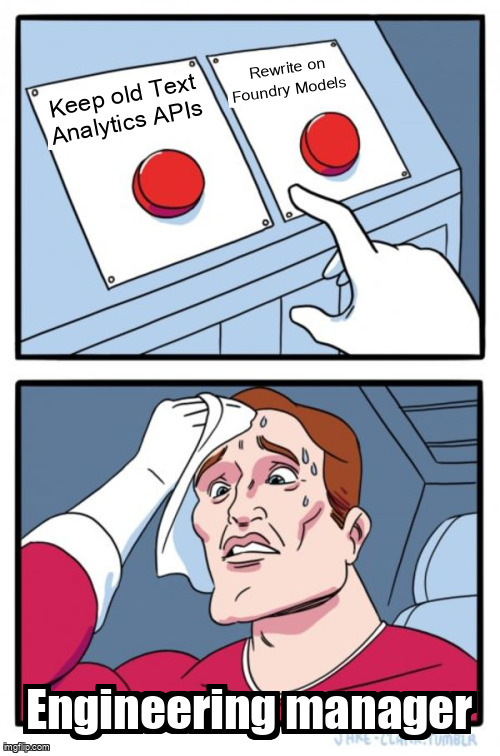
Integration path: what to do now
Microsoft is explicit that this is a multi‑year transition, not a fire drill (techcommunity.microsoft.com). A pragmatic plan looks like:
-
Inventory usage
Identify which services you rely on (Sentiment? CLU? Q&A?). - Map to Foundry patterns
- Classification → structured prompting
- Q&A → retrieval‑augmented generation (RAG)
- Summarization → constrained generation with evals
-
Adopt shared abstractions
In .NET, this often means centralizing model calls behind your own interface (or usingMicrosoft.Extensions.AI) so future model swaps don’t ripple through your codebase. - Plan observability from day one
Foundry emphasizes tracing, grounding, and evaluation. Skipping this early will hurt later.
Azure platform implications
This shift lines up with other recent Azure moves:
- Azure API Management is expanding AI gateway capabilities for multi‑model governance and routing (techcommunity.microsoft.com).
- Foundry is increasingly the “control plane” for AI workloads, not just a model catalog (thenewstack.io).
Taken together, Microsoft is nudging teams toward fewer bespoke AI calls and more standardized AI infrastructure.
Bottom line
If your app depends on Azure AI Language today, nothing breaks tomorrow. But the direction is clear:
- Task APIs are becoming patterns, not products
- Models are the unit of capability
- Engineers regain flexibility—and responsibility
Treat this as an opportunity to simplify your AI surface area before the clock runs out.
Further reading
- https://techcommunity.microsoft.com/blog/azure-ai-foundry-blog/transitioning-from-azure-language-features-to-foundry-models/4524092
- https://www.infoq.com/news/2026/06/microsoft-foundry-agents/
- https://thenewstack.io/microsoft-foundry-build-2026-ai-agents/
- https://techcommunity.microsoft.com/blog/integrationsonazureblog/whats-new-in-azure-api-management-at-microsoft-build-2026/4524683
- https://github.com/microsoft/Build26-news/blob/main/news.md