
.NET 11 Preview 5 lands—and it quietly reshapes how AI features fit into Azure apps
TL;DR: This week’s .NET 11 Preview 5 (announced June 9, 2026) doesn’t scream “AI release,” but it meaningfully smooths the path for AI‑heavy apps on Azure—especially around performance, hosting, and the emerging agentic patterns Microsoft highlighted at Build 2026. If you’re shipping AI features on .NET today, this preview is worth a look, even if you don’t jump to it in production yet. (devblogs.microsoft.com)
Why this preview matters to AI‑shipping engineers
At Microsoft Build 2026 (June 8, 2026), the .NET team framed .NET 11 as “built for the AI era,” with a strong emphasis on agentic web apps, tighter cloud integration, and performance predictability. Preview 5 is the first drop where those themes start to feel concrete for day‑to‑day engineers. (devblogs.microsoft.com)
If you’re building on Azure OpenAI or Azure AI Foundry today, three areas are especially relevant:
- Throughput and latency headroom
- Cleaner hosting for AI‑heavy services
- Fewer seams between app code and AI orchestration
None of these require rewriting your app—but they influence how confidently you can scale one.
Performance: small runtime wins add up for AI calls
AI apps are often network‑bound, but runtime overhead still matters—especially when you’re fanning out calls to models, tools, or vector stores.
.NET 11 Preview 5 continues the trend of incremental runtime and ASP.NET Core improvements aimed at:
- Lower request overhead
- Better async throughput under load
- More predictable tail latency
Those gains compound nicely with Azure OpenAI deployment options like provisioned throughput or priority processing, where you’re already paying for predictability. Shaving even a few milliseconds of app‑side overhead can help you stay within latency SLOs once the model responds. (learn.microsoft.com)
Translation: your AI app still waits on the model—but wastes less time everywhere else.
Hosting and “agentic” patterns feel less experimental
One recurring Build 2026 theme was the move from single‑prompt apps to agentic systems: apps that coordinate tools, memory, and multiple model calls.
Preview 5 itself doesn’t ship a brand‑new agent framework, but it aligns with:
- The direction of ASP.NET Core + Aspire for distributed, AI‑centric services
- The broader push toward standardized abstractions (for models, tools, and vector data) discussed in recent .NET sessions (devblogs.microsoft.com)
That means fewer custom glue layers and more “boring” (in a good way) hosting code—important when your app logic is already complex enough thanks to AI orchestration.
Cost control: previews don’t change pricing, but they change options
.NET 11 Preview 5 doesn’t alter Azure OpenAI pricing—but it makes it easier to take advantage of pricing models you already have:
- Provisioned throughput for predictable, high‑volume AI workloads
- Standard or batch deployments for background or offline inference
Cleaner async flows and better resource usage in your app tier help you right‑size those deployments instead of over‑provisioning “just in case.” Over time, that’s real money.
For teams watching token spend closely, this is a quiet but practical win. (azure.microsoft.com)
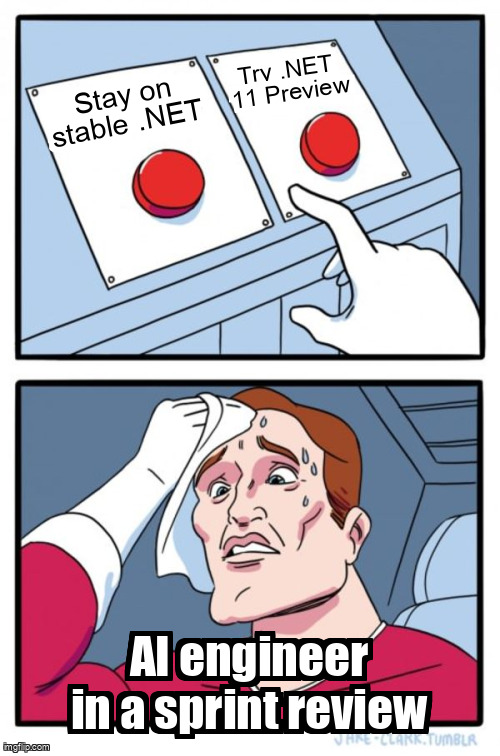
Should you adopt Preview 5 now?
Short answer: evaluate, don’t rush.
Good reasons to try it now
- You’re prototyping new AI features or services
- You want to validate performance characteristics early
- You’re experimenting with agent‑style architectures
Reasons to wait
- You’re in the middle of a production hardening cycle
- You rely on libraries not yet validated against .NET 11 previews
Preview builds are for learning and feedback—not surprise Friday night rollbacks.
What to do next (practical steps)
- Spin up a side branch targeting .NET 11 Preview 5 and run your AI‑heavy paths under load.
- Measure end‑to‑end latency, not just model response time.
- Compare costs when paired with Azure OpenAI standard vs. provisioned deployments.
- Feed findings back to the team—this preview cycle is exactly when feedback matters.
Further reading
- https://devblogs.microsoft.com/dotnet/dotnet-11-preview-5/
- https://devblogs.microsoft.com/dotnet/dotnet-at-microsoft-build-2026/
- https://learn.microsoft.com/en-us/azure/foundry/openai/how-to/latency
- https://azure.microsoft.com/en-us/pricing/details/azure-openai/
If AI is the engine of your app, .NET 11 is quietly tuning the chassis. You don’t have to race yet—but it’s worth a test drive.