Azure AI Just Got More Agent-Ready, and That Changes the .NET Playbook
Microsoft’s Build 2026 wave keeps landing in the same place: the center of gravity for AI apps is moving from “call a model” to “orchestrate work.” For .NET and Azure teams, the newest signal is less about flashy demos and more about the plumbing—durable workflows, sandboxed tool execution, tighter observability, and agent frameworks that fit real services instead of one-off notebooks. (devblogs.microsoft.com)
At a practical level, that means the architecture for AI features is starting to look less like a single API hop and more like a distributed system with opinions. Which, to be fair, is just microservices wearing a new hat. (techcommunity.microsoft.com)
The announcement that matters most: agents now have a more serious runtime story
The freshest development in this window is Microsoft’s push around the Microsoft Agent Framework and adjacent Build 2026 announcements. The framework is positioned as an open-source SDK and runtime for building AI agents and multi-agent workflows across .NET and Python, with added focus on orchestration, hosting, and observability. Microsoft also highlighted hosted agents, agent harness tooling, and CodeAct-style capabilities in the Build roundup. (devblogs.microsoft.com)
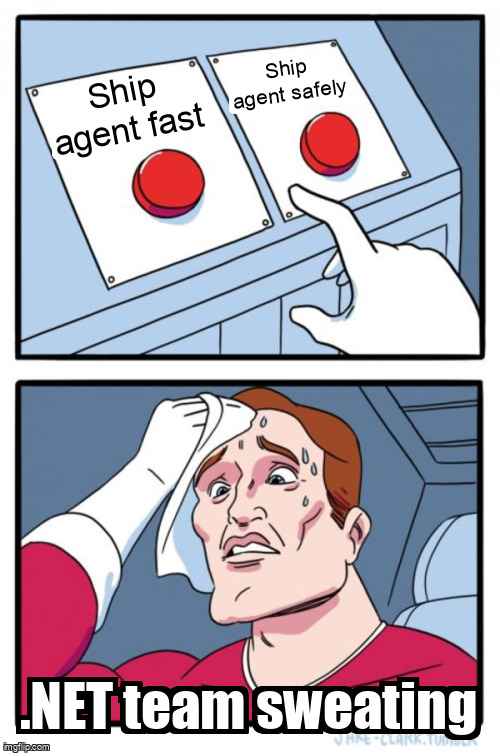
That matters because many teams have already learned the hard way that “agent” is easy to prototype and hard to productionize. The new message is: don’t glue agent logic into a controller and hope for the best. Treat it like workload infrastructure. (devblogs.microsoft.com)
Why .NET engineers should care
For .NET shops, the appeal is consistency. Microsoft has been describing the same core concepts and APIs across .NET and Python, which lowers the odds that your AI team builds one workflow model in one stack and a totally different one in another. That’s useful for shared mental models, shared ops, and shared debugging at 2 a.m., which is when all bugs become philosophical. (devblogs.microsoft.com)
The other big win is durability. Microsoft’s Build materials tie AI workflow scaling to Durable Task and Azure Functions, including references to Copilot-scale workflows and serverless agents. Translation: if your agent has to wait, retry, fan out, or survive a restart, there is now a much clearer story than “hold on while I keep this in memory.” (techcommunity.microsoft.com)
The other important piece: sandboxes change the safety model
GitHub’s new cloud and local sandboxes for Copilot went public preview on June 2, 2026, and the framing is useful beyond Copilot itself. The core idea is isolated tool execution, both locally and in the cloud, so agentic workflows can interact with code and systems without running loose in your primary environment. (github.blog)
For teams shipping on Azure, that suggests a cleaner boundary between model-driven reasoning and side-effectful work. If an agent needs to inspect a repo, build artifacts, or run a scripted action, sandboxing is the difference between “helpful assistant” and “unexpectedly enthusiastic intern with prod access.” (github.blog)
What this means for architecture
A sensible 2026 stack for an AI feature on .NET and Azure now looks like this:
- Orchestration layer: Microsoft Agent Framework or a similar agent runtime for multi-step logic. (devblogs.microsoft.com)
- Durable execution: Azure Functions and Durable Task for retries, state, and long-running work. (techcommunity.microsoft.com)
- Isolated tool execution: GitHub sandboxes or comparable boundaries for risky actions. (github.blog)
- Observability: Azure Monitor/OpenTelemetry-style tracing so you can debug the agent’s “thoughts,” tool calls, and failures. (techcommunity.microsoft.com)
The engineering takeaway is simple: agent UX is now downstream of platform design. Latency, cost, and reliability will depend less on the model choice alone and more on how often you call tools, how long you keep state, and how much work you can offload asynchronously. (techcommunity.microsoft.com)
Practical guidance for shipping teams
If you’re building on .NET and Azure this quarter, start here:
- Separate planning from execution. Keep the model’s reasoning loop away from side effects.
- Make every tool call observable. If it cannot be traced, it cannot be trusted.
- Budget for token and tool costs. More agent steps usually means more spend.
- Use durable workflows for anything user-visible. “Try again later” is better than “lost in RAM.”
- Sandbox anything that writes, deploys, or deletes. Even if it’s “just for preview.” Especially then. (techcommunity.microsoft.com)
A grounded bottom line
The latest Microsoft wave is not a single product launch so much as a shift in platform expectations: AI features are becoming first-class application workflows, and .NET/Azure teams now have more official building blocks for durability, isolation, and observability. If you’ve been waiting for the “real architecture” phase of agentic software, congratulations—your wait is over, and the fun starts in operations. (devblogs.microsoft.com)
Further reading
- https://devblogs.microsoft.com/agent-framework/microsoft-agent-framework-at-build-2026-announce/
- https://devblogs.microsoft.com/dotnet/introducing-microsoft-agent-framework-preview/
- https://github.blog/changelog/2026-06-02-cloud-and-local-sandboxes-for-github-copilot-now-in-public-preview/
- https://techcommunity.microsoft.com/blog/appsonazureblog/azure-functions-at-build-2026-update/4524075
- https://techcommunity.microsoft.com/blog/azureobservabilityblog/what%E2%80%99s-new-in-observability-at-build-2026/4524927
- https://devblogs.microsoft.com/dotnet/category/ai/