The Week AI Agents Became a Platform Decision
AI news for .NET and Azure teams is no longer just about “which model is best.” The more interesting story is that the platform layer is hardening: agent runtimes, observability, trust controls, SDKs, and governance are now the things that determine whether your feature ships or your incident page does. This week’s signal is clear: the winners will be the teams that treat agent infrastructure like production software, not a demo with a nicer hoodie. (devblogs.microsoft.com)
Microsoft’s Foundry push is the clearest example. At Build 2026, Microsoft expanded Foundry around hosted agents, Toolboxes, memory, voice, knowledge bases, and stronger evaluation and observability tooling. The key takeaway for engineers is that Microsoft is pushing the whole agent loop into a managed platform: runtime, grounding, testing, and operations. That matters if you’re shipping on Azure because it reduces the amount of glue code you need to maintain, but it also means your architecture choices are becoming more opinionated. Convenient, yes. Free-form, not so much. (devblogs.microsoft.com)
For .NET teams, the practical angle is SDK convergence. Microsoft’s Foundry docs now explicitly surface C# support, and the AI Projects client library for .NET exposes agents, deployments, connections, datasets, and indexes from a single client surface. That makes it easier to wire an agent into an existing ASP.NET Core service, but it also means you should design for clear boundaries: one service for orchestration, one for retrieval, and one for side effects. Your future self will thank you; your pager will too. (learn.microsoft.com)
GitHub also had a meaningful week for developers embedding AI into tooling. The Copilot SDK reached general availability on June 2, 2026, and GitHub’s June changelog shows the product moving fast with model choices, CLI improvements, usage metrics, and enterprise controls. If you build internal developer platforms, this is the kind of change that shifts AI from “an assistant in the IDE” to “a capability in your platform.” The engineering implication is simple: check authentication, tenancy, and policy integration early, because the hard part is no longer calling the model — it’s governing who can do what, and where. (github.blog)
OpenAI’s June updates underline the same theme: operational discipline. The OpenAI API changelog added workload identity federation on May 26 and pointed production users toward GPT-5.5 for API usage, while the deprecations page announced GPT-5 and o3 snapshot deprecations effective December 11, 2026. That is classic platform gravity: model churn is normal, but your app should not rebuild itself every time the headline model changes. Abstract the provider, pin the version, and keep a rollback path that doesn’t involve a prayer circle. (developers.openai.com)
Here’s the actionable weekly checklist for Azure/.NET teams:
- Separate orchestration from business logic. Keep agent policy, tool execution, and domain operations in different components.
- Instrument everything. Traces and evaluations are no longer optional extras; they are how you explain behavior when an agent takes a scenic route through production. (devblogs.microsoft.com)
- Assume model change. Use configuration and capability flags rather than hard-coding a single snapshot. (developers.openai.com)
- Plan for identity first. Workload identity federation and enterprise policy controls are the difference between “safe pilot” and “shadow IT with a GPU budget.” (developers.openai.com)
- Design for cost and latency. Hosted runtimes, managed compute, and better observability help, but you still need token budgets, caching, and retry discipline. (devblogs.microsoft.com)
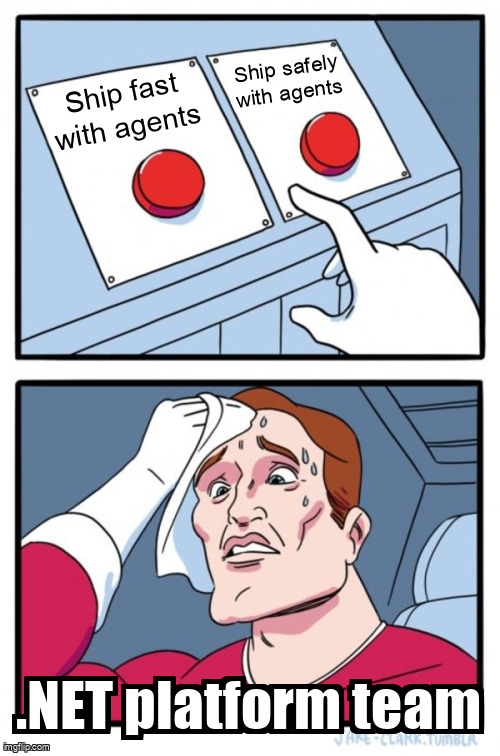
The preview for the next few weeks is straightforward: more production plumbing, more governance, and more pressure to prove ROI. That’s good news if you like building durable systems and mildly annoying for anyone hoping AI would stay a weekend science project. For engineers shipping on .NET and Azure, the smartest move is to adopt the platform pieces that reduce undifferentiated heavy lifting, while keeping enough abstraction to survive the next model rename, deprecation, or surprise “minor” API update. (devblogs.microsoft.com)
Further reading
https://devblogs.microsoft.com/foundry/whats-new-in-microsoft-foundry-build-2026/
https://devblogs.microsoft.com/foundry/build-2026-from-observability-to-roi-for-ai-agents-on-any-framework/
https://devblogs.microsoft.com/foundry/agent-service-build2026/
https://learn.microsoft.com/en-us/azure/foundry/how-to/develop/sdk-overview
https://learn.microsoft.com/en-us/dotnet/api/overview/azure/AI.Projects-readme?view=azure-dotnet
https://github.blog/changelog/2026-06-02-copilot-sdk-is-now-generally-available/
https://github.blog/changelog/month/06-2026/
https://developers.openai.com/api/docs/changelog
https://developers.openai.com/api/docs/deprecations
https://developers.openai.com/